Tuesday, October 21, 2008

Weather you like it or not

I went to England for the annual state visit this month and was pleasantly surprised to discover that being there didn’t bring up the bile in ways it has previously. I attribute this to the fact that I only stayed two weeks, and last went over 12 months ago. England is better in small doses. Like Wasabi sauce, or Alaa El Aswany [when was he nominated Egypt’s official spokesman exactly?].

The prolonged absence made everything a bit fresher I suppose, even if the rows and rows of terraced houses we descended over did remind me of prison wings.

I was unable to look out of the window too much because of the presence next to it of a South African lady of an indeterminable age who spent the flight alternately taking unsmiling photographs of herself looking out of the window ponderously, and doing Afrikaans word searches. Since I had got up at 6 a.m. I was obviously beyond word formation, and something about her cheerful smile and carefully-labelled rucksack told me that there would in any case be no such thing as a short chat with this woman. I was unwilling to be dragged into the skydive of an untrammelled conversation and quickly fell into a deep, dribbling, sleep.

Only to awake to find the woman straddling me. I imagine that somewhere there might exist a person who dreams of suddenly finding himself thus encumbered with a portly South African lady on a plane, but up until I was jerked out of my slumber, eye-level with a crotch, I had not realised just how high it was on my list of nightmare situations.

“It’s all right!” she said cheerily, smiling the perma-smile and rubbing me on my arm as she attempted to squeeze her way over/through my seat on her way to the toilets. It distinctly wasn’t all right, but the terror of it all had temporarily robbed me of an ability to speak.

When we entered British air space she knocked me on the shoulder – interrupting my viewing of ‘What Happens in Vegas’ – and exclaimed, “Look at the pretty little snowflakes on the glass! CAN YOU SEE THEM???” while pointing excitedly at said objects. I again found word formation impossible, and wondered whether it was advisable for her to be travelling unaccompanied – while wishing that I was.

Luckily my death stare did the trick eventually and I spent the rest of the flight unmolested, before successfully meeting up with my father (no mean feat). He decided that it would be fun for me and my suitcases to go home by tube and train, despite his being a car owner. This decision can only be attributed to his latent tendencies towards parental cruelty and privation, although he kept on going on about fuel prices and nearly-empty suitcases.

We arrived home (eventually and inconveniently) halfway through TV game show ‘Deal or No Deal’ which meant of course that my mother could not receive me immediately and instead launched into a spirited description of some women and her box, if you’ll excuse the expression.

Weather continued to provide the subject matter of 89% of conversations between strangers thrust together in everyday situations – gripes about the Mubarak clan fulfil the same role in Egyptian taxi cabs. I was assaulted with a continuous stream of tedious remarks about how wet/unexpectedly sunny it is, all of which I had no idea what to respond to with other than “yes”. My father claims they are conversational greasers, but never have I seen “it’s a bit better out, isn’t it, today?” evolve into anything other than “bye”.

One joker more than made up for that while I was in a bookshop in central London. “’Ello luv, got anything worth nickin’?” a voice behind me boomed, and I turned around to see a woman at an inquiry desk glaring at a grinning man. “Only joking!” he said.

News arrived shortly after I arrived in Blighty that Ibrahim Eissa had been granted a presidential pardon, and would not therefore, be going to prison for saying that Hosny is poorly. While I’m glad that Eissa isn’t going inside, there was surely never any real prospect of him doing time, was there? The regime cracked the whip in the sentencing, and that was enough. Maybe nobody said so at the time because they were scared of tempting fate, and because of the mercurial nature of this regime.

Saturday, September 27, 2008

Stability

I went to a place called Establ Antar (‘Antar’s Stable’) on Thursday, a place whose name makes it sound like something out of Aesop’s Fables. It is a slum area located between the Zahraa and Dar el Salam metro stations on one side, and the beginning of the Moqattam mountain on the other.

I was strangely captivated by the place, which I entered from a main road which became progressively narrower – like walking into the horizon – until it was nothing but a dirt track. Lining it was an assortment of constructions: huts, concrete buildings and above our heads houses attached to the cliff face like barnacles on a ship. The effect was of scrambled jigsaw pieces.

Goats, sheep and chickens roamed around between tethered donkeys and this, together with the absence of motorised vehicles (the streets are too narrow), and the sudden and unlikely open spaces dotted with scratching livestock almost lent the scene a sort of rural charm.

The effect was dispelled by the memory of the area underneath a flyover which I passed through, and which had a Armageddon-like quality to it: huge piles of black smoking rubbish dotted the landscape between the flyover’s imposing pillars and a couple of unsaddled white horses. The distant roar of the flyover’s traffic echoed round our heads. Here and there men squatted on the ground, possibly selling something, possibly just squatting. Greyish smoke from the piles of rubbish lazily curled its way up to the flyover above. Impossibly high, a giant fist about to clench..

I went with a colleague from work who, while I pointed out unusual sights, hung on to his bag ever more tightly and mumbled “I never thought I’d come to a place like this”. “Welcome to journalism,” I said. “This is the dark side of journalism,” he replied, morosely. His unhappiness seemed to increase proportionately the narrower the road got, until by the time we reached our destination he was largely silent and tight-lipped.

We were there because the government – presumably stung by the Doweiqa fallout - had decided to knock down unsafe houses. Their former occupants were not congregated in an angry huddle a street away from the site of their former homes, which had been cordoned off by the police. A wardrobe and various belongings were piled up next to them.

They told us that they had been forcibly evicted and taken to workers’ accommodation outside Media City, in the desert. They say that the place is unsafe for women and children, and that it doesn’t have drinkable running water. Furthermore, they say that they have been given accommodation leases, but that the leases are only temporary - for 45 days.

Behind them a tiny child squatted down in a pile of rubbish and defecated.

My colleague took me aside while we were talking to them. “They say that the police arrest journalists who don’t have permission to be here,” he said. One of the residents added, “they let you talk to us, and then they arrest you as you’re leaving.” I wondered how true this was given that 1. I hadn’t heard about any arrests despite the fact that thanks to Twitter (and now Jaiku) I am kept to date with the minutiae of journalistic movements including virtually the toilet variety and, 2. No one from state security had bothered us. Perversely, this made me uneasy.

Fear really is contagious, and as I looked at my colleague’s sweating brow, I felt that old feeling of queasiness and loose bowels which I haven’t felt since I went to see the striking train drivers in Beni Sueif and was offered tea by state security, in the middle of nowhere.

Since he didn’t have a press card, and was obviously uncomfortable, we left. I vowed never to work in a pair again.

“It’s very dangerous to work without permission!” my colleague said as we walked to the metro station. “Under the emergency law they can lock you up and you’ll never come out.”

I protested that we weren’t doing anything wrong, and that if we let the fear get to us we wouldn’t be able to write a single word. He wasn’t convinced.

“I showed compassion to them and everything but it’s 50% their fault, you know,” he then said.

“You what?”

“They come from the countryside when there’s no work to come to. Then they say that they don’t have any money, but how did they build these houses?”

I asked him whether he thought they had woken up one day and decided that it would be a good idea to leave their villages and come and live in a shithole. Did this also give the government the right to forcibly evict them from their homes, I wondered aloud.

“Listen, I’m an Egyptian and I know Egyptians. Nothing works except force. It’s been like this for thousands of years.”

My heart sank as we walked along. I felt like I had been on assignment with Margaret Thatcher - and this is a kid in the 3rd year of university. I’ve frequently encountered this outlook in Egypt amongst my generation and people in their twenties, and it never fails to unsettle me, this complete separation between ‘us’ – middle/upper class, respectable, decent - and ‘them’ – poor, swindling, idiots.

These groups when they are not invisible, are making pests of themselves with their collapsing homes and beggar children or duping the state into giving them public funds. They seem to be regarded as children, or morons, and the attitude would be paternalistic if it wasn’t for the complete absence of any kind of concern for their wellbeing.

Tuesday, September 16, 2008

Falling into place

I attended a family Iftar this week, attended by a cousin who has just completed a masters. She told me that she was thinking about working in real estate for a couple of years to make enough money to start a business in her field of expertise. “I want to make enough money to live at a certain level," she told me. She meant the Gouna and yacht level. I asked why she didn’t start out at the bottom of the ladder and work her way up, within her field. She complained that in the United States her qualifications would allow her to jump in halfway up, but that here she has to start at the bottom and, to top it all off, work with people “who are not my level.”

I pointed out to her that 98% of Egypt’s population are not her “level”. She said she realised this, but that she is determined to stay within her world, the bubble of privilege in which she has grown up.

Given that only one of the dinner guests was fasting, post-prandial discussion was lively and uncompromised by the post-food stupor fasting induces. I have always wondered what the husband of one of my cousins does: my aunt told me that she wasn’t really sure, but that he was a businessman of some sort.

“What do you do?” I asked him.

“I’m a businessman,” he said.

The vastness of this title, its ability to encompass the drug dealer, the cheating politician and the charitable change-maker, always makes me slightly suspicious. He clarified, slightly, but then I saw that he was wearing suede slip-on shoes without socks, which was another red flag. Turns out that he has spent enough time in Italy to acquire its nationality, which explained this.

The boom in the luxury housing market in Egypt is going to come to an end, was the consensus at Iftar. Supply has exceeded demand, apparently, and in 6 months we’ll witness a nose dive. Discussion of the housing market naturally led on to Hisham Talat Mostafa, property mogul turned inmate, which prompted slip-on man to share his theory about how those in charge at the top keep order.

Every 15 years, he claims, “they” topple prominent figures so as to remind them, and the rest of us, who’s steering the ship. He claimed to be able to list off the men who have fallen in these periodic waves…Nobody asked him to. He had another theory as well, which is that for two years Susie, rather than Hosny, has been running the country in concert with Gamal and his gang.

While he was out smoking a fag the rest of the Iftar guests murmured amongst themselves and poo-pooed his theories, before insisting that we all sit down and watch the mosalsalaat in order to stop him talking.

Conspiracy theories, gossip and rumours are a national sport in Egypt, but there was something chilling about this discussion, the idea of all these hidden strings pulling and controlling everything which happens here. The worst thing is that I came away feeling more than ever that indeed everything is stage-managed: the victories, the tragedies – everything, and that perhaps what we perceive as pushing boundaries is in fact just the momentary drawing back of the slingshot.


An example: on Monday I went to downtown Cairo, where homeless victims of the Doweiqa rockslide had spent the night in a public garden between the grandiose buildings of the Abdeen palace complex.

There were about twenty families there, the vast majority of them women and tiny children. They had come to Abdeen after being forcibly ejected from a makeshift camp by the police, who used sticks and dogs, rendering them homeless for the 2nd time in a week. They had come to Abdeen protesting the failure of the authorities to give them the housing they had been promised (in a letter) would be given to them “upon production of the documents establishing their legal claim to it.”

As usual this promise wasn’t kept, the authorities using various ruses to break it from claiming that the letter-bearers didn’t have the correct documents to ripping up the letters containing the promises.

And so there they were, in a public garden sleeping on donated blankets, their children running around indefatigably. I spoke to a pregnant woman about what had happened to her. As she spoke she absent-mindedly wiped grass off my jeans. I looked down and saw that her arm was a maze of orderly i.e. self-inflicted, cut mark scars.

There was a heavily-pregnant woman there, she was huge, and confirmed that she was due any day. Why aren’t you in hospital? I asked. I’m scared that they’re going to take my husband away, she replied.

Another woman was there with her 4 year-old daughter. She told me that she hadn’t been in her room at the time of the rockslide because she – and her daughter – leave for work at 6.30 a.m. She cleans houses. She built her single room using loans. The authorities are denying her replacement housing because, she says, she has not proved to their satisfaction that she is a resident of the affected area. Her ID says she is, but there we are.

While we were talking her daughter started crying. She was hungry. “Shall I get you a piece of bread?” she said. Yes, the child nodded. “7ader, hageeblek takly” [OK, I’ll get you something to eat].

A boy carrying empty mineral water bottles was given instructions to sell them and buy food with what he got for them.

A doctor friend arrived and examined those who needed medical attention, which included a young baby vomiting non-stop and numerous cases of diarrhoea. I asked people what I could get them to help, food, nappies, anything. I had to ask several times, to insist - which surprised me.

Amongst other thing I bought Pampers, and made the mistake of handing out the packets at random. A truly ugly scene followed - women accusing each other of hoarding and hiding at high volume – the pent-up frustration of a life of crushing violence and desperation (of which the rockslide is merely the latest instalment) suddenly erupting. An NGO woman told me to direct donations to one of them.

While all this was happening, a police officer summoned me, for the second time that day. I approached him.

“Yes? Is there anything wrong?” I asked him.

“Why are you so defensive?” he asked.

Could it be because of the tendency of the police to arrest journalists, I wondered silently. He asked me whether the nappies and food etc I was giving out was bought using my own money. You bastard, I thought, sitting there waiting to break your fast in your ironed jeans and designer glasses while you watch children run around in clothes stained by their own excrement.

He asked me for my journalist ID again, for the second time in two hours. I think they’re trained to do this as part of the process of wearing away at our nerves.

I had noted when I first arrived in the public garden that there was practically no security presence apart from a couple of uniformed officers and a smattering of plain-clothed men. Which was weird, and unsettling, particularly given the tiny numbers present during the protest some of the women took part in this morning.

It turned out that the plan, the grand design, was to remove the families, suddenly and without warning – hence no need for large numbers of police officers. They were taken away by the police in microbuses, and dumped in various areas of Cairo, forcibly removed by events beyond their control for the 3rd time in just over a week.

Friday, September 12, 2008

Bread & butter IV

Here I talk to Palestinian students of foreign universities stuck in Gaza cos of the Israeli siege.

This is my article on the effects of tourism on marine wildlife in Nasr City-On-Sea.

This is an article about EIPR winning a court case which freezes government plans to privatise health insurance.

This and this are articles about sit-ins by workers from subsidiary companies of the Suez Canal Authority.

Coverage of the Mahalla trial is here and here.

And this is an article about press coverage of the power cut in the El Matareyya Hospital.

Here's a link to a pop music video by a gentleman from Turkey called Tarkan. Mr Tarkan dances like an accountant called Steve at a Xmas office party before the consumption of alcohol has taken effect. The grey suit does not help in this regard. He nonetheless appears to think he is Justin Timberlake and is apparently one of the biggest grossing singers in Turkey, so what do I know.

Wednesday, September 10, 2008

Tanta

The Mahalla trial continued today, for the fifth consecutive day.


It’s being heard in Tanta, and I went there by Peugeot, one of the 7-seaters. I enjoy road trips generally, but there is something particularly mesmerising about travelling solo, and in an antique Peugeot, which remains one of the most comfortable cars I have ever deposited myself in. Today’s vehicle was no exception: it felt like we were being pulled across ice.


The last time I went to Tanta (on Saturday, also for the trial) I had gone by train and my introduction to the town had been a row of jumbled concrete tower blocks standing opposite the train station. I was happy to see that inside the town are narrower streets which, while they are not breathtaking architecturally, are kinder on the eye than the visual assault of the drag outside the court house.


I attempted to enter the court house from the entrance I had used last time, which seemed to me to be a logical idea. State security thought otherwise, and told me to use the staircase further along. No reasons were given, mostly because there weren’t any.


Low-scale harassment continued later, when the defence team retired to a screened-off cafe to enjoy a secret fag and a coffee, unseen by Ramadan’s everywhere eyes. On their way back, a relative of one of the defendants told one of the lawyers that the defence witnesses weren’t being allowed into the court house. He spoke to the state security officers, who were sitting on chairs opposite the court house in their tight jeans and open shirts. Things escalated after a security officer asked one of the lawyers when he graduated (!), again for no apparent reason.


The state security officer stood up, squared off to the lawyer as his colleague held him back. “Don’t try to make problems with me because I won’t let it happen,” he said. I was reminded of English pubs on a Friday night at closing time.


I noted that the other security officer had in his hand a load of ID cards, which appeared to belong to the defence witnesses given the way he shuffled through them when the subject was brought up. Why? Who knows.


Inside the court things were tenser than on previous occasions, partly because the lawyers are tired and disappointed that the media didn’t show up. They wanted cameras in court. It creates pressure.


Seven defence witnesses testified on behalf of their friends today, almost all of them were poorly dressed, unemployed or employed in modest trades – for this after all is a trial of the weakest, poorest and most ignored of Egypt’s population i.e. the majority.


One woman came clutching her tiny baby, which stared back at the court wide-eyed as she told the judge that her neighbour wasn’t even in Mahalla at the time of the demonstrations.


As she walked away her baby vomited lightly all over the floor, which I think, was the best statement on today’s proceedings.


Things exploded when the prosecutor began his pleadings before the court. He initially refused to speak into the microphone (which has replaced the loudspeaker used during Saturday’s session) and I soon understood his reluctance to do so.


After speaking at length about the political motivations behind the events of April 6th and 7th he went on to say that half of the 49 defendants have previous criminal convictions and, in the same breath, quoted a Quranic verse about individuals who spread depravity throughout the world (mofsedeen fel ard).


The effect was like dropping a match in hay. The defendants began screaming, shouting, tearing at their clothes while plain-clothed state security officers rose up from the benches and surrounded the cage in which defendants are held, some of them standing on benches, apparently trying to intimidate the defendants into silence.


“Kafara? KAFARA?!? [infidels] What else are you going to do to us?” they screamed at the officers. “He knows that we’ve been wronged” one defendant said, pointing at the prosecutor. “How can a Muslim label another Muslim an infidel?” another defendant shouted.


The judge adjourned the session while the shouting and the screaming got louder. An officer threatened to remove the defendants who were still shouting. “La2, e7na wa7ed” [no, we’re together] a defendant said.


It was extremely distressing to see their fury. In quoting this verse the prosecutor had attempted to harpoon what for some of the defendants is the only lifebuoy keeping them afloat in a sea of poverty, oppression and general meaninglessness – their refuge in faith. It was a dirty trick.


A state security officer stopped me photographing them beating their heads and tearing at their clothes inside the cage. Did I have permission from the judge, he asked, ignoring the fact that I had been photographing two metres away from the judge for the past three hours, in front of the whole court. Yes, I said, on the basis that silence amounts to tacit approval. He took me to the judge’s room. “Did you give her permission to photograph?” he asked the judge. “No,” the judge replied, annoyingly.


That ruse having failed, he demanded that I get rid of the photos. He asked me for the memory card. I gave him the battery. A policeman said “that looks like a battery,” not unreasonably. I said that I didn’t know where the memory card was.


N.B. This is not technically a lie. I do not, in fact, know where the memory card is stored.


The state security admitted that he didn’t know where the memory card was either, after I told him to remove it. Which is what I was counting on.


There are times when speaking the Arabic of a 10-year old, and being a 99% foreigner pays off, and this was one of them. Take the camera, I said. He closed his eyes and laughed and looked exasperated and basically said be off with you and don’t take any more pictures. A lawyer bundled the camera into his bag before the officer changed his mind.


The thing that will most stick in my mind about today’s session, concerns the defence witnesses.


Two of them were illiterate. They signed their statements with a thumb print. The woman with the baby, when she was asked how old she is, said, I don't know.


“Well when were you born?” the judge asked.


“I don’t know that, either” she said. “Look at my ID card, it’s written on there.”


It turned out that she was born in 1986. Mubarak had had five years - a presidential term - to give her half a chance by the time she was born. Twenty-two, a mother, and illiterate. Testifying on behalf of a man facing imprisonment because he doesn’t know the right people and can’t buy his way out.


There are some disposable Egyptians who can’t be got rid of through falling rocks. This, I suppose, is what the courts are for.


Friday, August 29, 2008

Whatever happened to baby Abdel Rahman?


Go to this link and laugh.

Things I like about this webpage:

1. The crack element.
2. The microphone invading the photo's foreground like a drunk prankster.
3. Hosny's shiny Duran Duran suit.

Which is best? Answers - with reasoning - in pencil, on A4 lined paper.

Class dismissed.

Tuesday, August 19, 2008

Will make no perceptible difference to the legislative process


The view from Dokki

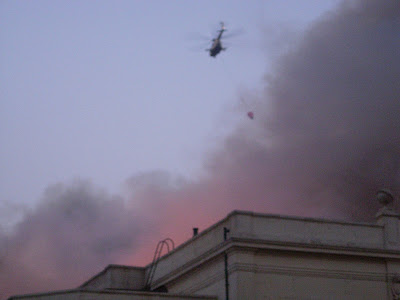
Today I got inordinately excited by the sight of a helicopter taking water out of the Nile.


I then felt slightly nauseous when I discovered that the emergency services’ response to the huge fire in the Shura Council was identical to its response to any event involving the gathering of ten or more people: throw huge numbers of central security troops at them.


7abeeb hearty ya helicopter

I walked to the fire across Qasr El Nil bridge, watching the helicopter scooping up water and throwing it (rather ineffectually) all over the Shura Council.

Arriving outside Qasr El Nil there was the predictable scene of chaos, caused mostly by the police, whose sole purpose in life seems to stop journalists standing still for more than 10 seconds. It is impossible to overstate how irritating it is, when you are trying to photograph something, to have some bloke waving you away like a chicken escaped from its coop.


The strategy tonight was to line the corners of the road opposite the Shura Council with a semi-effective police cordon, theoretically to keep people back. Its effect was to herd the crowds directly into the path of huge fire trucks trying to reverse out of the Shura Council into Qasr El 3ini Street.

We milled around Qasr El 3ini trying to avoid herded away and get photos and then decided to walk round the circumference of the Shura Council.


A bonkers man outside the AUC insisted that the Pig take a photo of him giving the thumbs up against a background of the fire while he shouted “ENTA AKEED FE MASR.”


On the Falaki side the fire was huge. We found a load of kids who had turned the roof of a bus into an impromptu viewing platform while below them a really old policeman roared at them to get down. He then preceded to chase kids who jumped down waving a tree branch at them in a scene which was part comedy, part tragedy.


This part of the evening, in a back street without any security presence apart from the old bloke was slightly anarchic, and slightly intimidating. At least for a lady.


Wanting to get a view from above, we attempted to bribe several bawwabs into letting us up but succeeded in stumbling across the most noble bawwabs in the world. Not for love nor money could we go up. The residents would get angry. We eventually though found a building with a separate fire escape staircase used by the people living on the roof, and an absent bawwab.


Alas we discovered the fact that it is only the fire escape leads to the roof only after climbing seven flights of the indoor stairs, at which point my patience began to wear thin but unfortunately not my thighs, despite the intense workout they were given.


The view from the roof was worth the terror of the ascent: the fire had completely consumed that side of the Shura Council, as you will see in the video if a miracle has happened and I have succeeded in uploading it.


My legs almost giving way, I left the fire at about 11 p.m. by which time it was starting to die down slightly.


I left terrified at the prospect of what would happen if, God forbid, Egypt ever suffered another mass scale disaster natural or man-made: emergency response services simply cannot cope. This is hardly breaking news, but was brought home in a slightly terrifying fashion tonight as fire engines got stuck reversing into anarchic streets and security forces shooed away people mechanically while being annoying and useless and ambulances got stuck in traffic jams.


What was really galling was that they did not even close Qasr El 3ini Street – Qasr El 3ini!! The street they close whenever a minister farts in its general direction. This was baffling, and the decision to leave traffic flowing through it and obstruct the passage of fire engines is testament to an extremely poor emergency response plan. Or, even worse, the complete absence of one.


Note on videos below (because I don't know how to annotate them without deleting them)


1. Shows the excellent helicopter doing its thing. I was standing on Qasr El Nil bridge.

2. View from left-hand side of main gates of Shura Council on Qasr El 3ini. Fire engines fighting their way through.

3. View from roof of building opposite the Shura Council, Falaki side. Shura Council completely in flames.

4. Left-hand side again.


**Special thanks to Zoss, who donated this video camera**

Videos of the fire. Guest appearance by: my finger

Sunday, August 17, 2008

Nasr City-On-Sea


A scene from The Shining

I have just returned from Nasr City-On-Sea, where I counted the minutes until my flight back to Cairo.

Last week was full of omens. First of all my mobile fell down the toilet while I was entering the starter's blocks and it was in my back pocket. This is the 2nd time I have done this, disproving Pavlov.

Then, as I was walking down Abdel Khaleq Sarwat, downtown, I saw a small object convulsing in the road, and realised that it was a cat, hit by a car. I dragged the creature, paralysed at the waist, to the side of the road, where I asked a store owner for a piece of cloth and a box so that I could take it to a vet to be put down. The store owner was very kind. Bystanders looked at me and shook their heads, feeling sorrier for the stupid foreigner than the bloody cat.

The sad thing is, attempting to rescue a cat did feel self-indulgent, in this age when there is not enough humanity to cover humans.

A grocery owner came out and placed a tub of yogurt in front of the cat, which was now frothing at the mouth, in agony. When the box and the blanket eventually arrived he shouted after me “take the yogurt! Cats like yogurt!”

The cat died in the taxi en route. I had never before witnessed a death, human or animal, and was shocked by how stealthy death is. One moment the cat was writhing in agony, desperate to escape the box, the next he was perfectly still. This happened when the taxi driver was asking me where I am from.

“Are you Egyptian or foreign?” he asked.

“Both” I said.

“Where is the foreign part from?” he asked.

“England” I replied.

“Aih? Cameroon?” he asked, inexplicably.

It’s true what they say, live things do look more at peace dead, even when fleas are still crawling over their heads. The cat was smiling.

I left the dead cat with my vet, where I washed death and germs off my hands in his sink. He had a tiny baby kitten corpse preserved in a jam jar of some liquid or other next to the taps. The kitten was standing up, defiantly, with its paws by its head. Roar.

On Thursday I went to Nasr City-On-Sea, for work. I had to get up at 4 a.m., and if life had given me a choice between getting up at 4 a.m. to go to Nasr City-On-Sea, and having my fingernails pulled out one by one, I would have hesitated.

There was no choice, and I found myself in the street wrenched out of sleep at that time when it is dark but technically a new day and only two birds and you are awake in the whole country, and then the next minute I was at the check-in desk, where I had a fight with a queue-jumper. Queue-jumpers are just above homicidal maniacs on my shitlist.

The fight refreshed me, and I was relatively awake on the plane, awake enough to register the safety video.

Just after the do3a2 el rokoob [prayer for travellers], and in the ‘gentleman’ of “Ladies and gentlemen, for your safety…” the electricity went out on the plane. Not just switched off, but a massive cabin-shaking power cut. People laughed nervously.

Being an Egyptair flight, this happened twice, at exactly the same moment. Star Alliance my arse.

Luckily it didn’t happen when the plane was actually in the air, and we arrived, technically alive, even if all of us to a man looked like death warmed up.

I was put in a 5-star hotel in Nasr City-On-Sea because I was there for work, one of those places where fruit is trapped under cling-film in your room and robes bearing the hotel’s initials spy on you from the wardrobe and you are charged for farting and you are meant to feel exclusive.

The bed had 10 pillows. I counted them.

Approximately eight of the TV channels were European. I watched a programme on male gymnasts in Dutch. Male gymnasts require no translation.

On the day I left I watched three hours of ‘Qalb emra2tin’ a soap opera featuring Ilham Shaheen, she of the huge teeth. It was awful, but it was about 420 degrees outside and I don’t dive, which left absolutely nothing else to do. At least 80 percent of the scenes were about nothing, by which I mean this model:

Girl: Allo

Boy: Aywa ya 7abibti [hi darling]

Girl: 3ala fekra, ana z3lana mennak [by the way, I’m upset with you]

Boy: Laih ya noosa!/ya Sooma!/ya Nivi! [why! –insert pet name --]

Girl: Le2an el saa3a ba2at 2 wenta makelemteneesh men el sob7 [because it’s 2 o’clock and you haven’t rang once]

Boy: Ma3lesh ya ro7y, asl ana mott fe 7adset 3arabeyya el saa3a 11 [I’m sorry babe, but I died in a car crash at 11 a.m.]

Girl: Tayyeb…ana mesh za3lana tab3an/m2darsh 3ala za3lak 2abadan/a variation on this. [Ok…I’m not really upset of course/I can’t stand to make you angry]

Nasr City-On-Sea is Nasr City, on sea, by which I mean a huge, ugly, built-up urban area next to the sea. There is absolutely no concession to the beauty of the surroundings whatsoever, unless you count painting buildings white a concession. It is an unremitting visual assault of the type of generic plastic-looking tower blocks indigenous to Egypt.

What is worse is that there is, as far as I can tell, absolutely nothing to do in Nasr City-On-Sea outside of ocean-based activities, and excluding staring at women in micro skirts.


Cheaper than Evian, non??

Attempting to fend off boredom I went for a walk one day, aiming to refuel at Felfela, and from there proceed to a hotel called Merit, which on the map appeared to be next door to Felfela. A concierge in the Marriott hotel (from where I started my promenade) had advised me that Felfela was only 800 metres away or so and that yes, I could walk it.

Twenty minutes later, and slowly getting pickled in my own sweat, I flagged down a taxi and told him that I wanted to go to the Merit hotel. “Ah, that’s behind us” he said confidently, and did a U-turn. Five minutes later he pulled up outside the Marriott. “El Merit” he said. It was that kind of trip.

For three hours on Friday I sat on the beach amongst Serbians and two middle-aged women having a fight in Arabic at high volume. One of them appeared to be foreign, but spoke heavily-accented, passable Arabic, or at least enough Arabic to accuse the other woman of not knowing what she was talking about. She sounded a bit like me, as it goes. A man sat between them and smoked resolutely, looking out at the ocean. He probably would have thrown his cares into said ocean, if he had been able to carry their substantial body mass.

A man from the hotel tried to sell me massages offered in the hotel’s health spa. I tried to stop him, explaining that I earn in LE, but he then said he’d give me a discount, and opened his folder to show various types of body manipulation available for only several hundred pounds.

He asked me where I am from. England I told him. He asked me my name. I told him. “It’s an Egyptian name!” he declared, ignoring its Semitic roots and universality.

“You are married to an Egyptian!” he asked/told me, as is obligatory.

“No.”

“You are not married!”

“No” I said, wondering if my he was an simultaneous incarnation of my mother and my guilty conscious.

“But why! I see queen before me!” was his stockpile response.

What, Brian May AND Roger Taylor? I wanted to ask him.

On the flight back home I was put at the very front of the plane and then an air steward closed the curtains in the aisle behind me and I realised that for some reason I was in business class.

While I can see the point of legroom and wider seats on long haul flights (but cannot justify their exclusion from economy class), business class seems utterly redundant and a vain display of self-importance on short flights such as these. Still, it’s not about legroom is it. A stewardess came round and threw a big white serviette on our foldaway tables which we were to pretend were table cloths before proceeding to put down a tray of two tired looking sandwiches, and two olives, all wrapped in Clingfilm.

Me and the man in the seat next to me (who seemed equally perturbed by the experience) sat and started at the sandwiches, smothered up to our necks in the serviettes, before we consumed them.

One was some sort of exhausted cheese, the other a sort of vile-looking meat. I also learnt that business class people (all eight of them) get a bus to themselves (although I missed it) while the other 80 plebs have to cram into a bus on their own. Everyone has to wait at the luggage carousel together though, so the upper-class suitcases mingled with their inferior brethren, even if their owners did not.

Tuesday, August 12, 2008

Doug Gibbs!*


My mother during her days as a ventriloquist

Happy birthday, Mum, and thank you for continuing to keep me in clothes and replacement mobile phones despite the fact that I have not yet kept up my end of the bargain and furnished you with a grandchild.

xxxxxx

* This is how my mother greets me on MSN.

Sunday, August 10, 2008

Keeping it in the family

While waiting for a bus at Gesr Soueis the other day I saw a man’s foot get run over by a microbus. A sudden screech of brakes and I turned round to see the unfortunate foot owner using both arms in order to extract said extremity out from under the wheel of the microbus which had elected to stop, rather than keep going and possibly reduce the damage. There was a certain gracefulness about it all, somehow.

In other news I came home yesterday to find four fire engines parked in the street perpendicular to ours and Upstairs Auntie amongst a bunch of people looking up at the sky.

“Where were you! I rang you a million times and knocked on your door to tell you to come and look at the fire! The smoke was pouring out and the smell was terrible!” she said, almost screeching with excitement.

“Where is it?”

“It’s out now but it was on that floor up there where that boy is standing. The firemen had to use the lift: their ladders weren’t long enough.”

The inevitable exchange then developed between Upstairs A and a bystander about the lamentable lack of equipment in Egypt and, where there is equipment, the lamentable lack of knowledge about how to use it.

On a related note, I watched an item on terrestrial telly the other day in which the authorities feted themselves on the purchase of X number of new ambulances on a stretch of highway somewhere in Egypt. There will now be an ambulance stationed every 50 km we were told – in between the billion LE luxury gated-community compounds overlooking these roads.

I can’t find anything about this new ambulance scheme other than this from our friends in the Egypt State Information Service: (I copy pasted. All spelling mistakes are theirs).

One billion pound was earmarked to carry out a comprehensive strategy to develop ambulance service in Egypt, Health Minister said Wednesday 4/7/2007.

In press statements, Hatem Gabali said the service will be equipped with 3,200 new ambulances, 1,000 of which will arrive in Egypt in 2007.

Money coming from selling lands for investors in the new communities will go to this purpose, he said.

He said the strategy aims at providing one ambulance for every 25,000 people in accordance with international criteria.

The plan will be finalised by July 2008. He called on businessmen to boost the ambulance service by offering money to buy 500 mew ambulances and train ambulance teams on the latest pre-hospital care methods.

The government is thus selling land to private investors and then generously investing the profits from these sales in the purchase of ambulances because the health sector is so screwed by the reduced public sector spending implemented under the conditions surrounding loan packages that the purchase of ambulances doesn’t just happen, it’s news.

And then after all that the government still has to go cap in hand to businessmen to pay for 500 new ambulances, the most basic and most important of a state’s obligations towards its people, keeping them alive, having again been reduced to – and reduced by – business, and chance.

Gated community dwellers unlucky enough to require one of the shiny new ambulances stationed every 50 km when it is already in use should remind themselves as they expire that the impressive economic growth due in part to slashed public sector spending and reduced state interference in the economy and increased foreign investment has allowed them to enjoy their desert kingdoms and its golf courses unencumbered by anything as inconvenient as meaningful taxes or a duty to others.

Poor people taken out on one these highways should be glad that they are no longer making a nuisance of themselves and being a parasitical burden on the entity formerly known as society and remind themselves that it’s all fate.

Speaking of roads and traffic, I saw a propaganda advert for the new traffic law the other day, the one with Yosra going on about safety belts in it, and at the end it said “the new traffic law: following it is no longer optional” or something along those lines. Which means that some drivers in Egypt have been needlessly abiding by the previous traffic law for all these years when they could have been doing handbrake skids into pedestrians with abandon.

It also made me wonder whether other laws are only optional. I believe this to be the case with legislation concerning gross criminal negligence and ship-owning members of the NDP whose ships sink killing 1,000 insignificant powerless people but who manage to turn potential criminal convictions into extra slices of cake at lunch: “not for me, thanks, I’ve had quite enough!” before buggering off to London.

Sunday, August 03, 2008

Feeling devotional


My camera can't keep up


My father, a librarian from Croydon, is a formidable collector of data, and will hunt down figures for e.g. total annual pencil production in Tajikistan with an assiduity last witnessed during the first NASA moon space landing.

I was therefore unflustered when I recently received an email from said parent with the subject heading: ‘moolid Sayyeda Zeinab’ and ‘When is it?’ in the main body of the text.


Knowing that he has no particular devotion to dried chickpeas, large crowds or saints, I concluded that the General Knowledge Database was being updated and promised him that I would find out. Serendipitously, the Sayyeda Zeinab moulid was this week, and I went - out of curiosity, and to collect statistics for Wikipedia my Dad.


The last time I was in a human sea of these dimensions was in Nasr City after Egypt’s triumphant win of the African Cup, when I watched people narrowly avoid setting each other’s heads on fire with improvised blow torches. Out of happiness.


The Sayyeda Zeinab moulid, while it also featured large numbers of young men, was a different vibe altogether, although as with the African Cup madness, I noticed a distinct lack of a visible police presence. This was made all the more obvious by the fact that I had gone straight to the moulid from a protest where about 60 protestors were policed by rows of riot police and the usual characters from the interior ministry.Funnily enough, this is the exact inverse of the situation in the UK, where football-related joy necessitates an army while political protesters are more or less left to get on with it.


During the moulid the street outside the mosque is necessarily closed to traffic. In its place are people. Thousands of them - mostly men - but families, too of course. Lining the pavements are hawkers - of chickpeas, masks, hats made out of biscuit wrappers, posters (Nasser, Mubarak, Shereen), sweets, masks, toys and pirated cassette tapes of popular Sha3by singers.


Children ride on ancient looking, battered fairground swings of the type which can turn a full 360 degrees. Amour informed me that where he lives ‘it’s half a pound to swing and a pound to go all the way round. But we don’t pay.”


“Why not?” I asked.


“Because the man in charge is bent and we know it,”


He didn’t expand.


The air reverberates with a million and one sounds from above and below and around; sounds of firework bangers, chanting – devotional and mercantile –, shouting and bass-fuelled pop music. Olfactory senses are equally bombarded, with the smells of donkey shit, rubbish, dust, Sheesha and cooking - the scent of an Egyptian summer.


The crowds making it virtually impossible to move in the vicinity of the mosque, we moved further out to a parking lot area which had been commandeered by a troupe of singers and musicians. Their presence was announced by a line of gallabeyya and 3emam-clad men peering into the parking lot, where a makeshift café had been set up.


Men and a few women sat around the perimeter of a small patch of scrubland within the parking lot, smoking, sheesha-ing and drinking tea. At one end a traditional band of Mezmar players stood behind the singer who alternated between modern pop classics, shout-outs and commentary on the dancers.

"Photograph el 7agg 7efnawy" the man on the left said. "OK" I said.


Needless to say, the dancing was A1, exuberant, carefree and best of all involved props (the inevitable sticks but also scarves – coquettishly tied round waists – and chairs – hoisted above heads). The Michael Flatley of this Riverdance was the gentleman to be seen here clasping a stick:


If it was up to me I would have stayed all night, but alas my companions were not seduced by the din, overpowering smells and suffocating crowds in quite the same way that I was. All showed forbearance, with their arms crossed and a tight expression on their faces. All except Amour who had arrived halfway through and whose first words to me were, “what the bloody hell is this nonsense you’ve dragged me to?”


Happy (me) and feeling slightly homicidal (everyone else) we retired to Gad, where Amour cheered himself up by indulging in a discussion of his two specialist subjects, Hashish and street-fighting. He taught us all a new word when he said on the phone to someone picking up a supply for him, “ha7ezak b3dayn” which apparently means “I shall reimburse you later.”


We were then regaled with tales of encounters between the police and the hardmen in the area where Amour lives and which were essentially an unwritten Human Rights Watch report involving the cops knocking people about in public. Amour regards it all as very normal. “law nezelto 3andy delw2ty mesh hatla2oo 7ad faye2. Kolo dareb.” [If you came to my area now you wouldn’t find a single sober person. Everyone’s stoned.]


“Yes but the police don’t have the right to beat people up”, I reminded everyone, thinking that I was stating the obvious.


“No but the area in which Amour lives is really rough, they’re vile, and nothing else works with them,” Umm Nakad the human rights lawyer informed me.